Check out Denver based- Prime of Life Tech

elderly-and-technology-11.jpg

Prime of Life Tech
Technical support for people in the prime of life

Patrick Baker, Founder of Prime of Life Tech provides older adults with technical support in the Denver, Colorado area and beyond. Independent seniors often want to use today’s technology for interacting with family and friends and managing their personal affairs.


Prime of Life Tech provides in-home and remote technical support for smartphones, tablets, computers, and more. He can troubleshoot and conduct minor repairs for your devices. He also offers training and follow-up support.
 

Independent Living Using Technology

Persons 55 and older – people in the prime of life – frequently have active lives. There is so much you can do with your smartphone, tablet, or computer to help organize and enjoy your activities:
 

  • Maintaining your appointments

  • Managing your email

  • Using social media

  • Booking travel reservations

  • Managing your bank and brokerage accounts

  • Communicating with family and friends using video chat like Skype or FaceTime

  • Researching family history or personal interests

  • Recording your story for posterity in writing, audio, or video

  • And so much more

These are just some of the things you can do with your smartphone, tablet, or computer. He offers services to help you get started or get updated with your technology so you can feel empowered – not intimidated – by your tech devices and apps.


Technical Support at Home or Remote
Prime of Life Tech provides in-home and remote technical support and training for smartphones, tablets, computers, printers, smart TVs, smart home devices, and more. As your technical support person, he will take the time to learn what you want from your devices and help you acquire the skills you need to feel empowered using your computer, smartphone, and smart home technology.

 
Visit http://primeoflifetech.com to see ALL the services he provides. You can also "Book an Appointment" or check out his Blog with lots of great tech related information.

He also teaches classes if your community would like to host him!


Bill HB20-1101 Could be on its way to the Senate by the end of the week!

th (6).jpg

We are thrilled that Bill HB20-1101 passed on second reading in the House this morning. Sometime this week the bill will be heard on 3rd reading.  

There is a real possibility for the bill to be on its way to the Senate by the end of the week!

If you aren't familiar with this bill please take a moment to ready the letter our owner submitted to the committee, along with many others, for it's first reading. Corky Kyle our lobbyist has been amazing at spearheading this and his communication with GDPRA throughout the process continues
to be encouraging. 

Thank you to Marnie Blin and the Government Affairs committee for all of your work on this legislation. 

This bill can do so much for this industry and our clients!
 

Bill HB20-1101-page-001.jpg

How to shop wisely at Dollar Stores

1351510040508e68186ba3a.png

Land great deals on groceries and more merchandise

While other U.S. retail stores are disappearing, dollar stores are popping up everywhere. In fact, the two biggest operators added 942 storefronts over a recent 12-month stretch, for a total of more than 31,000 sites. That's more than all the McDonald's and Starbucks outlets in the U.S. combined.

That's no surprise to anyone who has shopped in a dollar store lately. These retailers — Dollar Tree and Family Dollar (both owned by the same company), plus Dollar General — now carry all kinds of groceries, including brand-name products, in addition to usual dollar store fare like no-name batteries and greeting cards. A new study by the University of Nevada, Las Vegas, found that 84 percent of produce and 89.5 percent of non-produce items cost much less at these discount chains, and the produce quality is comparable to what's in supermarkets. But just because there are lots of bargains doesn't mean everything's a good deal. Here are five ways to save more at dollar stores — and avoid the duds.


1. Read the ingredients
When buying packaged foods like granola bars, crackers, soup and cereal from unknown brands, check nutrition labels. I found a box of granola bars that looked a lot like a Quaker Oats product. But the top ingredient in the dollar store product was high fructose corn syrup; Quaker Oats lists granola first.

2. Do the math
Sizes are often different at dollar stores, so it's not always easy to do a quick apples-to-apples price comparison. My advice: Before going, jot down unit prices of items you buy regularly at your grocery store. Then, if need be, use the calculator on your smartphone to compare those to dollar store prices. Some products aren't as cheap as they might seem. For example, I bought a 5-ounce can of shaving cream at Dollar Tree for $1, which comes out to 20 cents per ounce. Bed Bath & Beyond, though, sold a 10-ounce container of the same brand of shaving cream for $1.24, or 12.4 cents an ounce — 38 percent less.

3. Pile on the coupons
Dollar General and Family Dollar feature sales and juicy store coupons on their websites, plus they accept manufacturer coupons. You can also download dollar store phone apps for coupons on the go. The Family Dollar app's newly launched Smart Spins feature offers surprise coupons, and the store allows you to combine store and manufacturer coupons. Just be sure to check retailer websites for restrictions; for example, Dollar Tree — where everything truly costs no more than a dollar — accepts manufacturer coupons, but you're limited to four a day. Also sign up for email alerts to keep up on special deals.

4. Try the store brands
Though ingredients might not be the same as big brands, many are worth a try. For example, I found a small container of liquid Downy for 10 cents an ounce; Dollar Tree's LA's Totally Awesome private-label fabric softener was less than 2 cents an ounce. Major dollar stores may have multiple house brands. Dollar General's private-label brands include DG, Clover Valley, Heartland Farms, and Smart & Simple. Family Dollar's brands include Eatz, Family Chef and Silver Falls.

5. Review products carefully
The three big dollar store chains last summer settled charges from the New York attorney general that they sold obsolete or expired goods, including over-the-counter drugs. And in November, the Food and Drug Administration issued a warning to Dollar Tree about “potentially unsafe” over-the-counter drugs. So check expiration dates, and beware of super-cheap items that could pose a hazard.


by Lisa Lee Freeman, AARP, January 7, 2020
Lisa Lee Freeman, cohost of the Hot Shopping Tips podcast, was founder and editor in chief of ShopSmart magazine from Consumer Reports and a reporter for The Dr. Oz Show.

https://www.aarp.org/money/budgeting-saving/info-2020/dollar-store-deals.html?cmp=EMC-DSO-NLC-RSS-SAPLA--CTRL-020620-P1-4348980&ET_CID=4348980&ET_RID=36681338&encparam=wkysKG5P8%2fXrG29py%2b20OZ%2fGsl2lm6X5g3df6nxsIu4%3d

Why Coronaviruses Hit Older Adults Hardest

1140-corona-virus.imgcache.rev3d74c9b78809c122ca1dc540d6230b17.jpg

As with flu, immune changes and other health conditions are to blame

As cases of the novel coronavirus known as 2019-nCoV continue to rise worldwide, preliminary estimates suggest that older adults may be particularly susceptible to the respiratory illness, which can cause pneumonia and symptoms like fever, cough and shortness of breath.

"The data coming out of China continues to say that the people who are at higher risk for severe disease and death are those who are older and with underlying health conditions,” said Nancy Messonnier, M.D., director of the National Center for Immunization and Respiratory Diseases, a division of the Centers for Disease Control and Prevention (CDC), at a press briefing on Monday.

Preliminary estimates suggest that the virus, which has so far sickened tens of thousands and resulted in hundreds of deaths, has a fatality rate of about 2 percent. Early findings from China, which pertained to the first 17 people to die in the outbreak, revealed that their median age was 75, and a recent study in the New England Journal of Medicine found that the median age of the first 425 people infected with the virus was 59.

This is typical of coronaviruses, a family that includes the viruses behind the SARS and ongoing MERS outbreaks as well as other respiratory viruses like the seasonal flu, says Vineet Menachery, an immunologist at the University of Texas Medical Branch who studies the effect of coronaviruses on aging immune systems.

"During the original SARS outbreak, the lethality rate for the overall number of cases was 10 percent, but that lethality rate jumped to over 50 percent in people over the age of 50,” he says.


Underlying conditions play a role
Menachery points to two main reasons for older adults’ increased susceptibility to coronaviruses. The first is that they are more likely to suffer from underlying conditions that hinder the body's ability to cope with and recover from illness, such as chronic obstructive pulmonary disease.

The second has to do with how our immune response changes with age, the exact mechanisms of which Menachery and other researchers are still working to fully understand. His work with coronaviruses has shown that older mice, for instance, experience more inflammation early on in the course of illness, perhaps “setting the table” for lung damage that can't later be overcome (this novel coronavirus, like the ones responsible for SARS and MERS, affects the part of the lungs where gas exchange — the delivery of oxygen to the bloodstream and the removal of carbon dioxide — takes place).

"As you get older your lungs are not as elastic or as resilient as when you're younger. Those kinds of things, coupled with any kind of health issue you might have, trend toward this loss of airway function and respiratory function."

But, Menachery points out, this doesn't mean that turning 65 — considered the starting point of older adulthood by the CDC and other organizations — automatically puts someone in the high-risk category. “Age and your condition in life will really drive your susceptibility,” he says. “You may be in your 40s, but if you have these chronic health conditions, you're going to be more susceptible, just like you see with flu.”

Scientists are working to develop targeted treatments for 2019-nCoV. In the meantime, U.S. health officials recommend that people halt all nonessential travel to China and practice preventive hygiene measures, including thorough handwashing with soap and water.

The overall risk to the U.S. public remains low, the CDC's Messonnier said Monday. “The focus right now,” she said, “is on travelers returning from places where this disease rate is soaring."

Menachery also notes that the emergence of 2019-nCoV has overlapped with that of another potentially fatal respiratory illness: the flu, which remains at elevated levels across much of the country and has affected an estimated 19 million people so far this season, resulting in at least 180,000 hospitalizations (the majority of them among those 65 and older) and 10,000 deaths.

"It's not too late to get your flu shot,” he says. “It's actually been a really bad flu year.”


by Sarah Elizabeth Adler, AARP, February 5, 2020
https://www.aarp.org/health/conditions-treatments/info-2020/coronavirus-severe-seniors.html?intcmp=AE-HP-TTN-R2-POS3-REALPOSS-TODAY
 

Timeless Talks by Fairmount: High Tech aging and Caregiving

news-connectivity-feb18-humanmachine.jpg

High Tech aging and Caregiving with
Jane Barton

February 6, 2020: Thursday, Noon – 2:30 PM
Cherry Creek Retirement Village

14555 E Hampden Ave, Aurora, CO 80014

Please join us for a lovely lunch and beneficial discussion from Noon to 2:30PM about the impact of technology on the aging and caregiving experience. We will cover how technology can enhance communication and social connections, provide reliable safety and security systems, facilities good health and wellness and more.


Register by TODAY at CardinaLife@msn.com

One man turned nursing home design on its head when he created this stunning facility.

Wow! This is a truly unique memory-care facility. Amazing to see such innovative ideas brought to Senior living. 

92-year-old Norma had a strange and heartbreaking routine.

Every night around 5:30 p.m., she stood up and told the staff at her Ohio nursing home that she needed to leave. When they asked why, she said she needed to go home to take care of her mother. Her mom, of course, had long since passed away.

Behavior like Norma's is quite common for older folks suffering from Alzheimer's or other forms of dementia. Walter, another man in the same assisted living facility, demanded breakfast from the staff
every night around 7:30.

Jean Makesh, CEO of Lantern assisted living facilities, says he meets folks with stories like these every day. It's their stories that inspired him to make some changes at Lantern.

"I thought I knew a lot about elderly care. The more and more time I was spending with my clients, that's when I realized, 'Oh my god, I have no clue.'"

Confusion is common in Alzheimer's patients, but Makesh knew there had to be some way to minimize these conflicts.

A big believer in the idea that our environment has an enormous effect on us, he started thinking big — and way outside the box.

"What if we design an environment that looks like outside?" he said. "What if I can have a sunrise and sunset inside the building? What if I'm able to have the moon and stars come out? What if I build a unit that takes residents back to the '30s and '40s?"

And that was just the beginning. He also researched sound therapy. And aromatherapy. And carpet that looked like grass. No idea was off-limits.

What he came up with was a truly unique memory-care facility. And after testing the concept in Lantern's Madison, Ohio, facility, Makesh is opening two new locations this year.

Instead of rooms or units, each resident gets a "home" on a quiet little indoor street reminiscent of the neighborhoods many of them grew up in.

Instead of a boring panel ceiling, residents look up and see a digital sky, which grows dimmer late in the day to help keep their biological clocks in tune.

Throughout the day, nature sounds and fresh aromas like peppermint or citrus are piped in.
Some studies have shown that this kind of aromatherapy may indeed have some merits for improving cognitive functioning in Alzheimer's patients.

For Makesh, this isn't just about making patients comfortable, though. He wants to change how we think about the endgame of severe dementia.

Makesh said one of the frustrating shortcomings of most nursing facilities is that they create conflicts with unnatural environments and schedules, and they try to solve them by throwing antipsychotic and anti-anxiety medications at patients. In other words, when someone has severe dementia, we often give up on them. From there, they stop getting the engagement their brain needs to thrive.

Of course, we're a long way from a cure for Alzheimer's.
But Makesh's project shows that when we think strategically about altering the environment and focus on helping people relearn essential self-care and hygiene skills, the near-impossible becomes possible.

"In five years, we're going to [be able to] rehabilitate our clients where they can live independently in our environment," he said. "In 10 years, we're going to be able to send them back home."

He knows it's a lofty goal. And whether he'll meet it remains to be seen. But in the meantime, he's proud to own one of the few places that offers something pretty rare in cases of severe dementia: hope.


Link to the full article
https://www.upworthy.com/one-man-turned-nursing-home-design-on-its-head-when-he-created-this-stunning-facility?fbclid=IwAR1pNdwG4ixamKVcqZMWBRunjbeEJMTViTcyQEbCjmE7M7-Ef9bhJEvXDJQ

5 Star Review!

customer-reviews.jpg

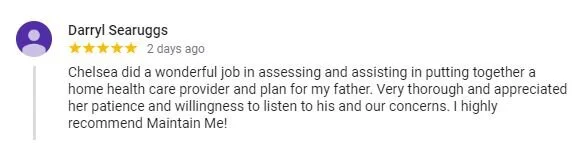
We couldn't be happier to close out the month with yet another 5 Star Review!

We love what we do and are so appreciative for kind and honest feedback Darryl. 

DSearuggs review.JPG

Certified Placement and Referral Specialist. A certification that is specifically designed for placement agents.

5fff4318-5bda-40e9-b61c-267723dd3df0.jpg

Maintain Me is so excited to be in the first testing group to receive the new Certification from GDPRA! 

Certification Update from:
Chuck Bongiovanni, MSW, MBA, CSA, CFE
NPRA Board President & GDRPA

A team of 17 agents met in Denver for 3 days to begin the process of writing questions for our certification. We decided that the certification will be called CPRS. Certified Placement and Referral Specialist. The first test to be held in January in Phoenix and will be tested end of January here in Denver with hopes to have the first test taken in February.


A note from your Public Relations Committee:

Definition of a credential/certification:

Credentialing is a rigorous, thorough, and systematic approach to collecting and verifying a professional's and company's qualifications. 


What does this mean for the community?
This certification will allow the community to identify the local companies who are involved with the GDPRA and acknowledge that they have taken the step and commitment to adhere by best practices to best serve our senior population. 

It not only is a financial commitment to take on such a credential but also is designed to show the experts in this field.


What does this mean for our industry?
It gives our long serving agents a way to shine through experience and knowledge backed by certification.

It gives our newer agents something to work towards as they gain knowledge in the field.

It brings a level of professionalism and credibility to our industry. 


ABOUT NPRA OF GREATER DENVER

There is a growing need to bring professionalism and best practices to our industry. Placement services offer an invaluable service to families. The local NPRA of Greater Denver chapter is working diligently to develop additional best practices for the NPRA of Greater Denver chapter and hold placement services accountable in Greater Denver and throughout Colorado.

Visit the GDPRA Website

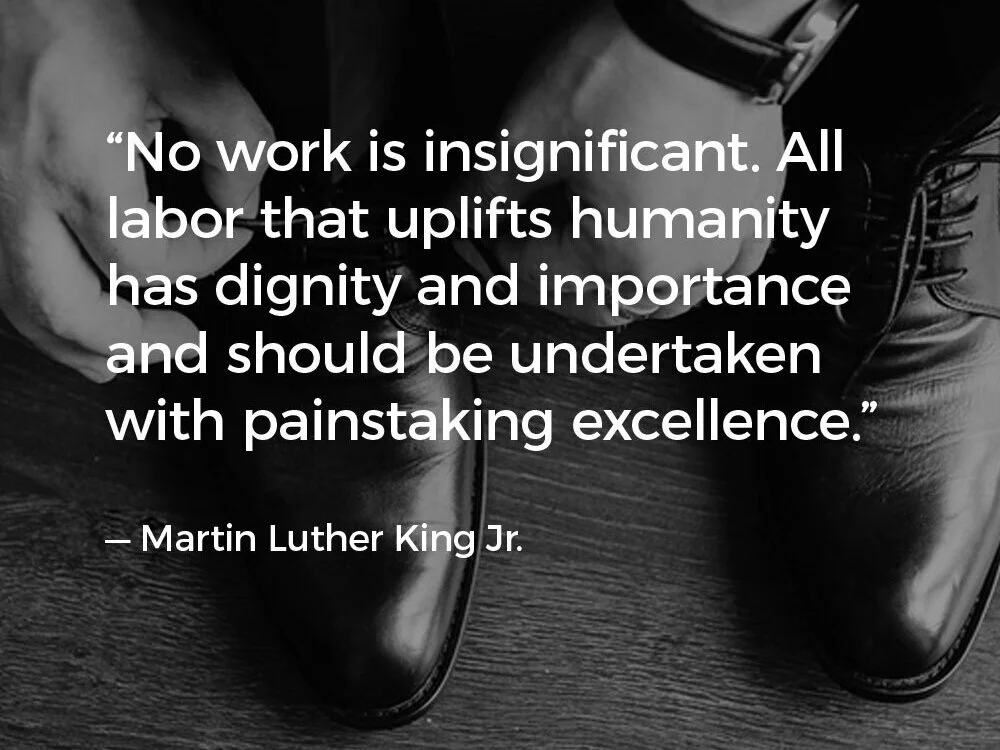
We hope you enjoyed your MLK Day

mlk-day-quotes-yfs-magazine-2.jpg

We strive to provide our aging population with compassionate service and dignity.

THANK YOU to our strong network of community partners who work with us everyday to make that possible! 

Check out our recent Review!

Review 1.16.20.JPG

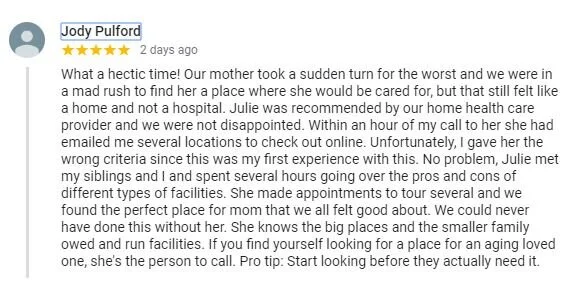
A big thank you to Jody Pulford for the amazing review!

We understand that your time is precious but hearing your honest feedback is invaluable. We are constantly working to serve our clients and their families to the best of our abilities and reviews like this let us know that we are on track. 

Great articles from seniorgardener.org

older-woman-gardening.jpg

Many thanks to Kim Dalton with Senior Gardener for sharing some great articles related to senior health. If you have any interest in gardening be sure to check out her site http://seniorgardener.org/


Senior Fall Prevention
https://www.caring.com/caregivers/fall-prevention/

How to Remodel for Accessibility
https://www.angieslist.com/articles/how-remodel-accessibility.htm

Comprehensive Room-by-Room Home Safety Guide for Older Adults
https://www.thezebra.com/senior-home-safety-guide/

Downsizing Your Home for Retirement? Incorporate These 10 Features to Age in Place Longer
https://www.homelight.com/blog/downsizing-your-home-for-retirement/

Why Seniors Should Avoid Isolation
https://living.medicareful.com/why-seniors-should-avoid-isolation

At-Home Services that Can Help Senior Veterans
https://www.homeadvisor.com/r/home-services-that-help-senior-veterans/

The Health Benefits of Pets for Older Adults
https://www.nextavenue.org/health-benefits-pets-older-adults/

The Safety of Seniors: Handyman Program

9360296.jpg

What may seem like a small job can be a big expense for seniors living on a fixed income. The Handyman program helps tackle those odd jobs around the house that might otherwise be put off due to lack of funds.

This is a great resource to help Seniors stay safe and independent! 


Anna McCaffery
Program Coordinator
Handyman Program
Yard Angels • Rake-Up • Snow Buddies • Cool Down

Office: 720-264-3334
amccaffery@voacolorado.org
 

Handyman Do s and Don t Flyer (1)-page-001.jpg


Water: Do we really need 8 glasses a day?

dehydratedSnr-182377079-650x450.jpg

We often hear that we should drink eight 8-ounce glasses of water a day. However, there is some controversy about this figure and what it really means.

Water is an essential nutrient. It is necessary to sustain all forms of life, and humans can only live a few days without it. It is also a healthful drink.

Health authorities and others often encourage people to consume 2 or more liters of water a day, but is this only plain water or does water from other sources count?

How much plain water do we really need?

Fast facts on water intake

Here are some key points about daily water consumption. More detail and supporting information is in the article.
 

  • Foods and fluids, including water, are the main source of water in our bodies.

  • The advice to drink eight 8-ounce glasses of water a day is not based on evidence.

  • The amount of water we need depends on individual needs and circumstances, including activity and climate.

  • The healthy body naturally maintains a well-tuned balance of fluid, and the thirst mechanism tells us when we need more.


In 1945, the U.S. Food and Nutrition Board advised people to consume 2.5 liters (84.5 fluid ounces (fl oz) of water a day, including fluid from prepared foods.

Today, the Centers for Disease Control and Prevention (CDC) say, "There is no recommendation for how much plain water adults and youth should drink daily." However, there are recommendations about total fluid intake from all sources.

Older adults may be at risk of both dehydration and overhydration, as a result of health conditions, medications, loss of muscle mass, reduction in kidney function, and other factors.


Older adults who are well hydrated have been found to have:

  • fewer falls

  • less constipation

  • in men, a lower risk of bladder cancer

  • Dehydration has been linked to a higher frequency of:

  1. urinary tract infections

  2. confusion

  3. kidney failure

  4. slower wound healing


Few studies have looked at fluid input and output in older people, but at least one has concluded that it is not significantly different from that of younger people.

Those caring for older people are encouraged to provide fluids regularly and assist with ambulation, especially if a reduction in mobility makes it harder to visit the bathroom.

Sources of water
Water in the body comes not only from drinking water.

Estimations vary, but according to one source: around 20 to 30 percent comes from food, some 60 to 70 percent comes from drinking water and other fluids and a small percentage, about 10 percent is "metabolic water," produced by cells during normal cell function

*The more active the body is, the more metabolic water is produced.

Some surveys suggest that around 20 percent of water intake comes from foodstuffs and the rest is from fluids. This depends on diet. A higher intake of fresh fruit and vegetables will mean a higher intake of water from foods.


The CDC urge people to make sure they drink enough water before, during, and after physical work, especially if this involves activity in a hot climate. This can help maintain alertness and effectiveness.

In a hot environment, you may need one 8-ounce cup every 15-20 minutes, but not more than 48 ounces in one hour, as this can lead to hyponatremia, a low level of sodium.

Plain water provides hydration without adding calories or jeopardizing dental health. Sports drinks can be useful in moderation, but too many will add unnecessary sugar to the body.


There is sooo much more information about water in this article. To read more about types of water such as tap vs.bottled, coffee intake, exercise, calculating water needs. Please check out the full article
https://www.medicalnewstoday.com/articles/306638.php#-calculating-human-water-needs-

Snow Buddies needs your Help!

370de889-01e6-4c02-a4e1-05be30195dba-6533538_G.jpg

When creating our post about Safe Snow removal last week we wanted to include the link for the Denver Snow Buddies program. Only to find that the program is in hiatus due to lack of volunteers.

What?! C'mon Denver, no way! 

Snow Buddies is a partnership between the City and County of Denver and Volunteers of America. The Snow Buddies program connects healthy volunteers with anyone 60+ in the metro area who cannot shovel their own walk. Volunteers are paired with seniors within a 2-mile radius of one another, helping clear their walkways after two or more inches of snow has fallen.

Why Volunteer?

When you sign up to be a Denver Snow Buddy, you are strengthening our community, improving someone else’s life and transforming your own life through service. The Snow Buddy program was initiated to keep seniors safe from falls on snow or ice during the winter. The program also keeps seniors from accruing city fines for not being able to shovel their snow from the sidewalks.
 

How to volunteer to be a Snow Buddy

You can fill out an application to volunteer at www.voacolorado.org/Volunteer/Snow-Buddies or contact the program director Anna McCaffery with Volunteers of America Colorado at
303-297-0408.
There is a one-time fee of $25 for a background check.


Don't let the fee deter you! PLEASE CALL. You may live in a high need neighborhood of Denver that is eligible for the fee to be waived!


Snow removal Safety Tips

th.jpg

The holidays have come and gone but the snow is here to stay. Colorado has already gotten its fair share of winter snow and now is a good time to assess if you have a safe plan in place for removal. AARP breaks down tips for safe shoveling. 

Get ahead of the snow: Before a snowstorm, put salt down on the pathways near your home to help melt snow before it sticks.
 

Take care of your back: Using a shovel to remove heavy snow can put a strain on your back if not done properly. To keep your low back safe:

  • Look for a lightweight shovel with a curved handle.

  • Walk around the block to warm up your body; stretch your lower back and legs after shoveling.

  • Face the snow that you want to lift straight on.

  • Bend at the hips (not the low back), bend your knees, and lift with your legs.

  • Lift only a little snow at a time to keep the loads light.


Protect your heart: Strenuous movement in cold temperatures can constrict your blood vessels while increasing your heart rate and blood pressure, putting some at risk of heart attack. To lower your risk:

  • Talk to your doctor if you’re unsure whether it’s safe for you to be shoveling snow.

  • Don’t shovel first thing in the morning after you wake up. Give your body time to warm up.

  • Use a small shovel to decrease the strain on your body and work slowly, taking frequent breaks to rest.

  • Wear lots of layers to keep warm.


Wear shoes with tread: Prevent slipping by wearing snow boots or shoes with a gripping tread on the bottom.


If you feel that you cannot remove snow and ice from your walkways safely it is important to get a plan in place. Reach out to neighbors first before paying a snow removal company with may get costly.


This article was featured at AARP:
https://heretostay.aarpfoundation.org/how-tos/remove-snow-and-ice-from-pathways/?utm_source=Here+to+Stay%3A+Home+Upkeep+for+All&utm_campaign=152e5830e2-EMAIL_CAMPAIGN_2019_11_12_11_42_COPY_01&utm_medium=email&utm_term=0_e3a52a2794-152e5830e2-363297695

HowTo_RemoveSnow.png

Life Care Holiday Event

8cab72d7-6a21-4c16-b54b-30aa6d59d4f5.jpeg

Thank you Life Care for hosting such a wonderful event!

This years Life Care Holiday event was full of cheer and wonderful community partners. Let me take a second to describe the scene... You walk into Berkley Manor greeted with Life Care personnel helping guide you to sign in. You received a stocking for when you walked the halls full of goodies from each community. Each table a different community and the ability to meet crucial team members awaiting to fill your stocking. The stocking stuffers were creative, homemade and fun. Community partners fill the halls catching up and learning all that Life Care has to offer. Maintain Me has been to a lot of events but this one in particular was a team favorite!

Thank you Life Care for a great holiday party and for all that you do for our aging population!

Celebrating Holidays with Seniors in Assisted Living

739d67c9-c348-408b-ad1c-9e47a7bbcb50.jpg

Holidays in assisted living communities can still be fun, festive, and meaningful even if it means creating new traditions.

Older adults in assisted living will feel loved and included when you find ways to bring the holiday spirit to them. After all, what’s most important is spending quality time with people you care about. 

To help you find new ways to celebrate, we answer 3 top questions:

Should you bring your older adult home for a family celebration?

What should you do when an older adult is no longer aware of holidays?

What festive activities work well in assisted living?


1. Should I bring mom home to celebrate with the rest of the family?
If your mom doesn’t have dementia and you can handle her physical needs and transportation, visiting the family home could be a great way to celebrate the holidays.

But before deciding, talk with her to see how she feels about it. 

She may be concerned about getting too tired or needing help with personal care. Reassure her by explaining how her needs could be met.

If she’s feeling shy or afraid that she’ll be a burden during a fun time, remind her of how much the family is looking forward to seeing her.

If your mom does have Alzheimer’s, dementia, or other cognitive impairments, it may be disorienting to take her out of a familiar environment. Staff members who know her well may be able to help you decide what would work best.

Some people with dementia enjoy festive events, but others are easily rattled by changes in routine, loud noise, or crowds.

If your mom is likely to get agitated, it might be better to have a quiet mini-celebration in her room or just have a regular visit.


2. My Dad has dementia. This year, he doesn’t seem to know that it’s the holidays. Will he even know or care if I celebrate with him?
Even if your dad doesn’t seem engaged with the world, he’ll still enjoy spending time with you and family.

You may or may not want to take him out of his memory care or assisted living community, depending on how well he usually does with outings.

If he typically enjoys going out, then it may be a good idea. If not, turn a visit into a festive occasion if that’s likely to bring him joy.

It’s a perfect time to reminisce over old photos, sing along or listen to holiday music, or admire cheerful decorations.

Unless he becomes agitated or upset by the activities, noise, or change in routine, seeing you in the holiday spirit will likely brighten his day.


3. What activities can I do to celebrate the holidays with someone in assisted living?
If your older adult has dementia, a low-key approach to the holidays may work better.

Overstimulating holiday activities or busy decorations could be confusing or cause agitation.

First, start with a few simple decorations and smaller groups of visitors and see how things go. You can always add more or take some away depending on how they react.

For seniors without cognitive impairment, find creative ways to help them take part in family celebrations.

Reassure your older adult that they won’t be forgotten or abandoned by telling them when you’ll celebrate with them.


Try these festive activity suggestions:

  • Decorate their room together – get a mini tree, use garland to make a tree-shaped outline on the wall and tape ornaments onto it, put a few decorative items around the room, or hang a wreath on the door

  • Help them think of and purchase gifts for family members (especially grandkids) and then wrap them together

  • Arrange a family visit and open presents together – it’s more fun when the whole group has presents to open

  • For family living far away, arrange video chats so they can have virtual visitors

  • Accompany them to a holiday event or meal hosted by the assisted living community

  • Sing along with or listen to holiday songs together

  • Watch a holiday-themed movie

  • Work on a holiday-themed puzzle or a fun coloring page


This article was featured at Daily Caring.com:
https://dailycaring.com/how-to-celebrate-holidays-with-seniors-in-assisted-living/?utm_source=DailyCaring&utm_campaign=5089f7a0bb-DC_Email_2019-12-17&utm_medium=email&utm_term=0_57c250b62e-5089f7a0bb-123200633 

Happy Holidays from Maintain Me Senior Services

52fab282-f7eb-40e0-a47e-3cec24d2592f.jpg

Merry Christmas & a Happy New Year
from our family to yours!

A little smile, a word of cheer,
A bit of love from someone near,
A little gift from one held dear. 
Best wishes for the coming year
These make a Merry Christmas!

-John Greenleaf Whittier