Older adults still struggling to get a Covid-19 vaccine

eight_col_60396800_l.jpg

As hospitalization and deaths from Covid-19 continue, many of the nation's 50 million seniors over 65 are struggling to navigate a confusing digital landscape of vaccine distribution plans that can differ from state to state and in some cases, county to county.

Here was the original plan. In December, the US Centers for Disease Control and Prevention's Advisory Committee on Immunization Practices recommended a phased process for states to follow.

Phase 1a was to vaccinate the most at risk -- health care workers and elderly in long-term care facilities.

In Phase 1b, vaccines would be given to people ages 75 and older and non-health care frontline/essential workers, according to the committee.

Phase 1c would include people over age 65 and anyone between 16 and 64 years old with high-risk medical conditions, as well as any essential workers not already vaccinated.

Phase 1a has been underway for the last month in all 50 states and Washington, DC, according to an analysis published this week by the Kaiser Family Foundation (KFF). In many cases, hospitals and clinics took on the task of vaccinating workers, while CVS and Walgreens tackled the long-term care facilities.

Immediately, however, some states went their own way. In Florida for example, where the Simons live, Gov. Ron DeSantis included all people over 65 into the 1a group. Other states added police and firefighters, while others included the incarcerated and homeless. Thirty states have tweaked the guidance and added in additional groups, KFF found.

While most states are still in some version of phase 1a, 10 states and Washington, DC have moved into Phase 1b, and Michigan has begun to implement 1c, according to KFF.

Communication to the public on which phase a state is in, how to find a vaccine and where to go to get the shot is left up to the state, typically the state health department, which may then leave it up to the county level to organize and administer.

In Georgia, for example, there are different phone numbers, websites, vaccine distribution centers and appointment links for each county. Yet people can book an appointment across counties, creating a confusing patchwork of detective work for the individual.

Then there is the issue of supply.

"What is challenging for our local health departments is the complete unpredictability of supply at this moment in time," said Lori Freeman, the CEO of the National Association of County and City Health Officials.

"Even when you have vaccination efforts going on, what we're seeing across the country is they're coming and going because this supply is not predictable," Freeman said. "They're being canceled at the last minute, and that sort of thing, so the predictability of the vaccine supply is at issue here."

That could mean the vaccine could be scarce for some weeks, said Dr. Marcus Plescia, chief medical officer for the Association of State and Territorial Health Officials.

"We are hearing there is not a stockpile of vaccine for second dose but that it was more of a 'paper exercise,'" Plescia said. "Until there is a more robust supply we need to be clear with the public that opportunity to get the vaccine is limited."


Colorado has launched new COVID-19 vaccine hotline

1-877-CO VAX CO (1-877-268-2926)
Currently staffed, 24 hours a day, 7 days a week

https://covid19.colorado.gov/


Article sourced from:
https://www.cnn.com/2021/01/15/health/senior-vaccine-struggles-wellness/index.html

Morgan's Success Story

older-couple-700-350.jpg

Being positive even at your breaking point.

I recently helped a man and his wife. The couple has been married for many years. They enjoyed traveling, she loved tennis, and they care very deeply for one another.

A close call happened that left them both shaken and in search of answers. His wife has been living with dementia for a few years, but the last several months had gotten really hard. He did everything he could to take care of his wife at home-- this story is not new, and yet it was hard and painful in the same way many of the other stories of couples living two lives under a dementia diagnosis.

But what makes this sad story a success story for me was my client's overwhelming trust in himself, and his positive outlook.

We worked very quickly to find a solution for his wife's increasing care needs. She was weak, a fall risk, neither one of them were sleeping, and the whole situation was headed for a (another) disaster.
My client and I would talk and email multiple times a day... and each time he would find a way to be positive.

On the day he moved his wife into her new home he said, "A plus of getting older is that I have experienced large problems, as always, the biggest healer is time." He was being brave, he new he had to be, because he could no longer keep his wife safe at home. Ultimately, he leaned on his life experiences to know, I can do hard things, and time will help me heal.

The first few days after his wife moved in, he preferred email to talking because he would often break down and cry... but a week later, he and his wife did their first window visit. He was apprehensive before going, fearing the worst, but being the positive thinker he is, hoping for the best.

He happily reported that she looked and acted WELL!

She was emotionally stable and in good spirits. He was relieved beyond measure. He was brave, he made a hard decision, knowing it was best, he remained strong even though he was ready to break, and he has found great relief in knowing that his wife is well.


Morgan Leigh Jenkins, MA
Transition Director

Phone: (303) 847-6861
Morgan@maintain-me.com

Happy Valentine's Day from MM

We took some time this week to think about what we LOVE about working with Maintain Me. As you will hear in the video, we have a great team and take every opportunity to get together (even if it's virtually) and have fun.

As we wind down the week and prepare for a very cold weekend we would love to hear what you are "loving" right now.

Feel free to comment below the video!

Financially preparing for Long-term Care

Do you have a plan on how you are going to pay for Long-term Care?

Need help bathing, dressing, home chores/maintenance or just companionship but don't know if you can afford it. It's time to start planning for the future. Medicare does not pay for Long-term Care.

If you missed our video from last week below is the article we are diving into. It's loaded with some very striking statists that shed light on some major misconceptions Americans have regarding
Long-term Care.

PBS NewsHour
By- Jason Kane


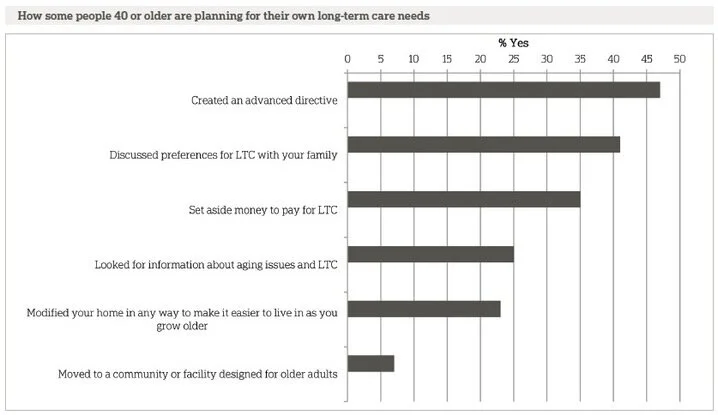
It’s a classic case of denial. Roughly half of Americans above the age of 40 believe “almost everyone” is likely to require long-term care as they age. Just a quarter think they will need it for themselves.

The truth: 70 percent of Americans older than age 65 will need some form of long-term care.

That gap means most Americans are doing very little to plan and save for the assistance they’ll desperately need in old age, according to a new poll from the The Associated Press-NORC Center for Public Affairs Research.

“It’s rather surprising,” said Jennifer Agiesta, director of polling for the Associated Press. “Very few people have arranged to pay for or even to think about their own needs. Most haven’t even taken the basic step of talking to family members about their preferences.”

The problem will only become worse as America grays, with the number of seniors expected to nearly double by the time the last of the baby boomers turn 65. In 2030, seniors are expected to make up 19 percent of the U.S. population — up from 12 percent in 2000.

After interviewing 1,019 Americans aged 40 or older in the nationally representative survey, the pollsters highlighted several startling conclusions:

52 percent said they had “a great deal or quite a bit of concern” about losing their independence and having to rely on others as they age.

44 percent said they were moderately worried about being able to pay for the care they might need.

35 percent had actually set aside money to pay for their long-term needs.

Why such rampant lack of planning? For one thing, Agiesta said, “people tend to guess wrong when they think about how much long-term care will cost them.” They underestimate the costs of nursing home care, overestimate the cost of assisted living and “are all over the place when you ask them what the costs are for a home health care aid,” she said.

To an equal extent, they believe Medicare has their backs. Close to half — 44 percent — expect Medicare to pay for ongoing care at home by a licensed home health care aide, and 37 percent believe it pays for ongoing care in a nursing home.

But it doesn’t. As the AP-NORC report points out, Medicare only pays for “medically necessary care in a skilled nursing facility.” In rare cases when home health care is approved, it’s provided “under very limited circumstances and for brief stretches of time.”

Meanwhile, 54 percent of the survey participants said they don’t anticipate needing Medicaid, the largest payer for long-term care — even though many of them lack confidence in their ability to pay for those same services as they age.

But the bigger issue may be that most Americans simply don’t want to think about aging.

Nearly a third of those polled said they “would rather not think about getting older at all.” When pressed, 52 percent said they had a “great deal” or “quite a bit” of concern about losing their independence and having to rely on others as they age. And 42 percent said they worried about having to leave their own home and move into a nursing home.

The survey found that “significant majorities” prioritize almost anything that will give them more independence. That includes purchasing homes with no stairs and living close to family members, health care services and stores. Nearly seven in 10 were confident they’ll be able to rely on family members “a great deal” or “quite a bit” in a time of need.

Even though most older Americans “aren’t doing much” to prepare for their own long-term care, the vast majority are supportive of a program that would help them do so, Agiesta said.

Roughly three-quarters of those 50 and older — a full 77 percent — support tax breaks to encourage saving for ongoing living assistance, similar to a 401(k). Half favor a government-administered long-term care insurance program, like Medicare. And about a third support a requirement that individuals purchase long-term care insurance.

Policy options aside, Agiesta said one of the biggest obstacles will be counter-acting the widespread belief among so many Americans that “other people are going to require much more care” than they will themselves.

“As they approach this age and this stage of life, people should be thinking more critically about what they’re going to need,” she said. “Because it’s probably not that different than what everybody else is going to need.”

The SCAN Foundation, which funded the AP-NORC survey, is an underwriter of the PBS NewsHour. . All graphics were produced by The Associated Press-NORC Center for Public Affairs Research.

https://www.pbs.org/newshour/health/as-boomers-age-most-woefully-unprepared-for-long-term-care

LTC3_slideshow.jpg

‘Hug tent’ provides safe embraces at Colorado elderly home

hug-2.jpg

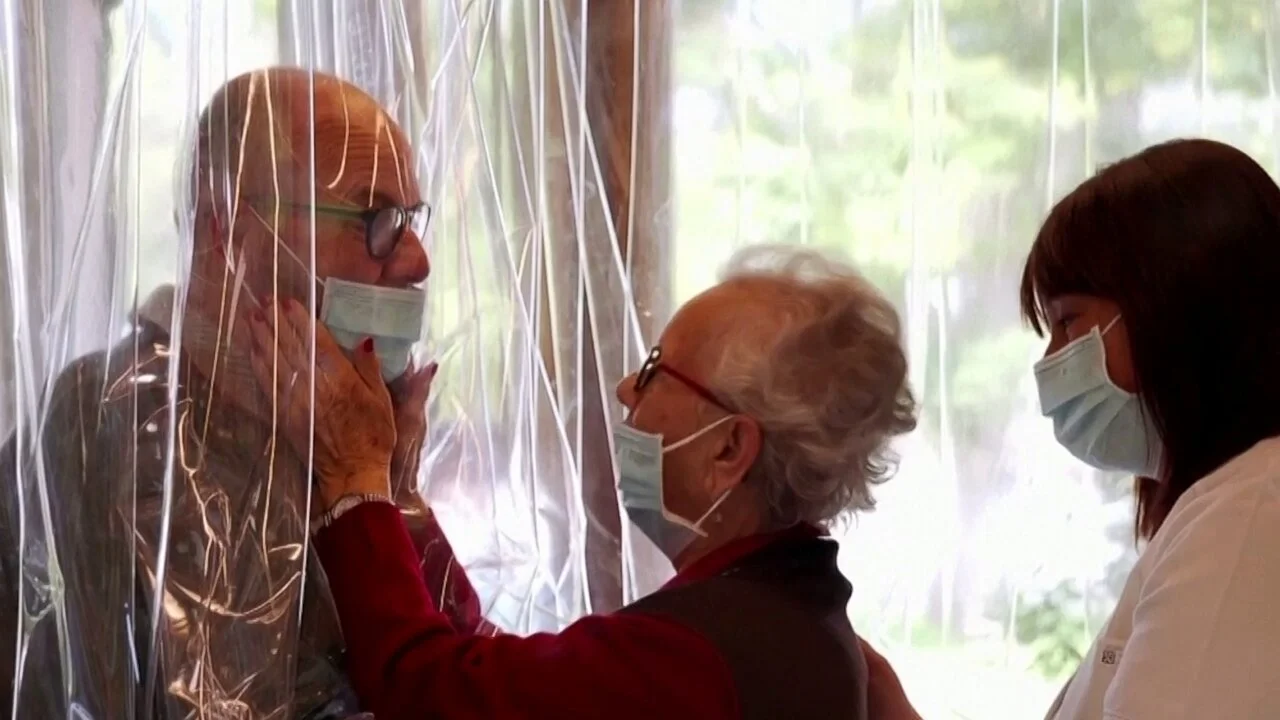
Lynda Hartman, 75, embraces her 77-year-old husband, Len Hartman, who suffers from dementia in a "hug tent" set up outside the Juniper Village assisted living center in

Louisville, Colo., Wednesday, Feb. 3, 2021.

Lynda Hartman needed a hug.

It had been at least eight months since she touched her 77-year-old husband, Len, who has dementia and has been at an assisted living center in suburban Denver for the last year.

On Wednesday, she got a small taste of what life was like before the coronavirus pandemic.

Sort of.

Thanks to a “hug tent” set up outside Juniper Village at Louisville, Hartman got to squeeze her husband — albeit while wearing plastic sleeves and separated by a 4-millimeter-thick clear plastic barrier.

“I really needed it. I really needed it,” the 75-year-old said after her brief visit. “It meant a lot to me, and it’s been a long, long time.”

Hartman, who fractured two vertebrae and could no longer take care of her husband by herself, said she thought he was a little confused but that it was important for them to embrace again.

“We’ve been trying to do it for a long time,” she said. “It felt good. I kept hitting his glasses when I hugged him, though. And he got cold.”

Although the setup wasn’t ideal, Hartman said, “At least you can do something, and it’s important.”

Since the pandemic hit, similar tents have popped up around the country and in places like Brazil and England, where some people call them “cuddle curtains.”

The assisted living facility in the Denver suburb of Louisville, which has fully vaccinated its residents and staff, partnered with nonprofit health care organization TRU Community Care to set up the tent with construction-grade plastic on a blustery but warm winter day this week.

“I think it’s just a huge weight off their shoulders, just being able to have that hug that they haven’t had in so long,” said Anna Hostetter, a spokeswoman for Juniper Village at Louisville. “When we were planning this and setting it up, and I saw pictures, I wasn’t sure if with all the plastic and everything you could really get that human contact. But I teared up on some of them. It was really special for our families.”

The hug tent will go up again Tuesday, and staff are planning to keep hosting them.

For Gregg MacDonald, holding hands with his 84-year-old mother, Chloe MacDonald, was important because they hadn’t touched since April. She likes to get updates on her grandson and granddaughter.

“Time is a precious commodity, so while we all wait to get back to more normality, in the meantime, everyone is doing what they can,” Gregg MacDonald said. “So I appreciate any efforts that they are making to allow us to have more contact with everybody.”

Amanda Meier, project coordinator for TRU Community Care, said she, her husband and some volunteers built the hug tent around a standard 8-by-8-foot popup frame and attached the construction-grade plastic with glue and Velcro. Plastic arm sleeves built into the tent are attached with embroidery hoops.

Since the beginning of November, she has helped set up four hug tents in Colorado and said the feedback has been positive.

“Lots of tears, but happy sort of tears, and a lot of shocked expressions of how in the world can we be doing something like this. It’s so weird,” Meier said.

But after the initial weirdness, the benefits are clear, she said.

“You can see sort of relief in their bodies and their faces when they finally get to have that physical contact, which is really a basic human need. And in these facilities, a lot of times they’re missing it anyway because they’re just not with their families,” Meier said. “I don’t think it’s measurable, really. You just know it when you see it and feel it when you’re there.”


Link to original article:
https://nypost.com/2021/02/05/hug-tent-provides-safe-embraces-at-colorado-elderly-home/

Americans are seriously unprepared for Long-term Care

The biggest point to take home is that Medicare ONLY covers care when there has been a change in condition it does not cover Long-term Care costs.

It is extremely important to plan for your Long-term Care needs now and understanding how you do that is the first step. Be sure to watch our upcoming videos to learn more about Long-term Care.

PBS NewsHour
By- Jason Kane


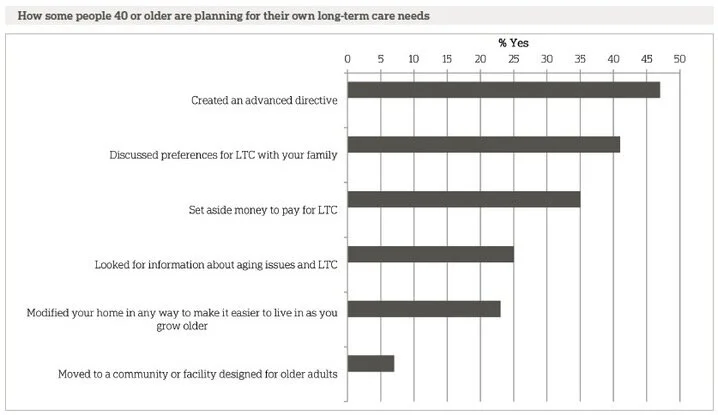
It’s a classic case of denial. Roughly half of Americans above the age of 40 believe “almost everyone” is likely to require long-term care as they age. Just a quarter think they will need it for themselves.

The truth: 70 percent of Americans older than age 65 will need some form of long-term care.

That gap means most Americans are doing very little to plan and save for the assistance they’ll desperately need in old age, according to a new poll from the The Associated Press-NORC Center for Public Affairs Research.

“It’s rather surprising,” said Jennifer Agiesta, director of polling for the Associated Press. “Very few people have arranged to pay for or even to think about their own needs. Most haven’t even taken the basic step of talking to family members about their preferences.”

The problem will only become worse as America grays, with the number of seniors expected to nearly double by the time the last of the baby boomers turn 65. In 2030, seniors are expected to make up 19 percent of the U.S. population — up from 12 percent in 2000.

After interviewing 1,019 Americans aged 40 or older in the nationally representative survey, the pollsters highlighted several startling conclusions:

52 percent said they had “a great deal or quite a bit of concern” about losing their independence and having to rely on others as they age.

44 percent said they were moderately worried about being able to pay for the care they might need.

35 percent had actually set aside money to pay for their long-term needs.

Why such rampant lack of planning? For one thing, Agiesta said, “people tend to guess wrong when they think about how much long-term care will cost them.” They underestimate the costs of nursing home care, overestimate the cost of assisted living and “are all over the place when you ask them what the costs are for a home health care aid,” she said.

To an equal extent, they believe Medicare has their backs. Close to half — 44 percent — expect Medicare to pay for ongoing care at home by a licensed home health care aide, and 37 percent believe it pays for ongoing care in a nursing home.

But it doesn’t. As the AP-NORC report points out, Medicare only pays for “medically necessary care in a skilled nursing facility.” In rare cases when home health care is approved, it’s provided “under very limited circumstances and for brief stretches of time.”

Meanwhile, 54 percent of the survey participants said they don’t anticipate needing Medicaid, the largest payer for long-term care — even though many of them lack confidence in their ability to pay for those same services as they age.

But the bigger issue may be that most Americans simply don’t want to think about aging.

Nearly a third of those polled said they “would rather not think about getting older at all.” When pressed, 52 percent said they had a “great deal” or “quite a bit” of concern about losing their independence and having to rely on others as they age. And 42 percent said they worried about having to leave their own home and move into a nursing home.

The survey found that “significant majorities” prioritize almost anything that will give them more independence. That includes purchasing homes with no stairs and living close to family members, health care services and stores. Nearly seven in 10 were confident they’ll be able to rely on family members “a great deal” or “quite a bit” in a time of need.

Even though most older Americans “aren’t doing much” to prepare for their own long-term care, the vast majority are supportive of a program that would help them do so, Agiesta said.

Roughly three-quarters of those 50 and older — a full 77 percent — support tax breaks to encourage saving for ongoing living assistance, similar to a 401(k). Half favor a government-administered long-term care insurance program, like Medicare. And about a third support a requirement that individuals purchase long-term care insurance.

Policy options aside, Agiesta said one of the biggest obstacles will be counter-acting the widespread belief among so many Americans that “other people are going to require much more care” than they will themselves.

“As they approach this age and this stage of life, people should be thinking more critically about what they’re going to need,” she said. “Because it’s probably not that different than what everybody else is going to need.”

The SCAN Foundation, which funded the AP-NORC survey, is an underwriter of the PBS NewsHour. . All graphics were produced by The Associated Press-NORC Center for Public Affairs Research.

https://www.pbs.org/newshour/health/as-boomers-age-most-woefully-unprepared-for-long-term-care

LTC3_slideshow.jpg

Coloradoans 70+ Find out where you can get vaccinated

vaccine.jpg

Coloradoans age 70+ are eligible to receive the COVID Vaccine. The state wide distribution is organized by county using healthcare providers online platforms. 

Because vaccine supplies are limited, not all current recipients will have access to the vaccine at the same time. The state of Colorado is coordinating with local public health agencies, health care providers, pharmacies, and diverse community partners to distribute the vaccine as equitably and efficiently as possible.

Many hospital systems in Colorado are now working to schedule vaccine appointments with Coloradans age 70 and over, who are eligible to get vaccinated as part of phase 1B -- and many more are working to come online. In some cases, hospitals will reach out to their patients. In other cases, patients of these hospitals may sign up to be contacted about scheduling a vaccination. The rate at which hospitals are able to vaccinate Coloradans age 70+ depends on the federal supply of vaccine. Because we are trying to move as fast as we can, we will provide information as soon as it’s publicly available, and we ask that you be aware that it will evolve, change, and grow over time. The following list details how patients of these providers can sign up to be notified when a vaccine becomes available.


Click on the link below to find a provider in your county and sign up
https://covid19.colorado.gov/for-coloradans/vaccine/where-can-i-get-vaccinated#70


*Be advised Coloradans age 65-69 are eligible to get vaccinated beginning February 8.

MEMORY CARE: Assisted Living for Alzheimer's & Dementia

1374085242000-Alzheimers-Cancer-Connection-1307171422_16_9.jpg

If you’re looking for assisted living for an older adult with dementia, Alzheimer’s, or other cognitive impairments, a memory care community is a good option. 

They’re places where seniors with dementia can get specialized care.

Daily Caring explains how memory care is different from assisted living, how much it costs, and share two checklists you can use to evaluate a memory care community.

How is Memory Care different from Assisted Living?
Memory care communities have environments that are secured against wandering and specially designed to be calming and easy to navigate.

There’s 24 hour supervision and a higher staff to patient ratio for a greater level of care.

And in memory care communities, staff are specifically trained to work with older adults with cognitive impairments.

Memory care residents get help with important daily tasks, like taking medication, bathing, dressing, and eating.

There are also structured activities, exercise, and therapy programs.


How much does Memory Care cost?
Because of the specialized care and larger staff, memory care usually costs more than other senior living options and, on average, about 20-30% more than assisted living

Since the average cost of assisted living in the U.S. is $4,300 per month, memory care would be about $5,375 per month.

This is a national average – costs can differ by thousands of dollars per month in different states.

That’s because memory care costs usually reflect an area’s cost of living. When trying to keep costs low, consider communities in less pricey neighborhoods.


What to look for in a Memory Care community
Finding a good memory care community for your older adult can feel overwhelming.

At first glance, every community might seem the same and blur together. That’s why it’s helpful to have a way to compare them.

This handy evaluation checklist (see button below) of questions helps you evaluate Alzheimer’s and dementia care communities based on the quality of care provided and practical aspects — for example, how easy is it for you and family to visit that location?

This additional dementia care checklist (see button below) has questions that focus specifically on issues that are important in dementia care.

The questions give you a framework for differentiating one community from another so you can find the best fit for your older adult’s needs, budget, and personal preferences.

Evaluation Checklist
Dementia Care checklist

Nearly one year later...Success story Update

o-CHRISTMAS-LOVE-facebook.jpg

You can easily picture an older woman with grey hair, a little messy from sleep, cradling her long haired black cat sitting smiling in front of a brightly decorated Christmas tree, wearing her equally bright Christmas pj's.

Another image harder to imagine because it is so painful: an older woman, disheveled, confused, agitated, and fearful, homeless needing an ambulance because she is found to be in distress in a super market parking lot.

I have described the same person now compared to a year ago. We had a Maintain Me 'Moment of Joy' when seeing her picture in a recent Holiday News Letter from the Assisted Living that her friend and POA helped pick out because she was not able to do so from the hospital.

This moment of joy, of a life saved from sure destruction, would not have been possible without a lot of people coming together. It took both the efforts of Chelsea and myself to help this client. It was not all rainbows, that's for sure. The assisted living had to take a chance, the client had to be willing to trust which was a big issue for most of her life because of trauma after trauma, and we had to be willing to take on a case that we weren't sure of the outcome. Did we have the resources to help her? We were willing to try...


We loved seeing a smiling, happy version of our client this Christmas, what a relief to know she was safe, and cared for. These small updates keep us going when things are really hard. And we all know last year's miracles exist out there, if you are looking for them!


Morgan Leigh Jenkins, MA
Transition Director

Phone: (303) 847-6861
Morgan@maintain-me.com

10 Steps to Reform and Improve Nursing Homes

5fad607cb2ac5f4ee8140b76_o_U_v2.jpg

Expert insights on how the industry should evolve in response to COVID-19

It's complicated. This phrase has become the default and arguably lazy response to many 21st-century challenges. But when it comes to finding ways to reform and improve America's nursing homes, it is sadly accurate.

The roots of the long-term care industry's problems are deeply tangled, as we reported in the December issue of the AARP Bulletin. The institutions that serve so many older and infirm Americans were created based on rules and laws passed decades ago, when needs and expectations were different. Nursing home funding and oversight come in large part from government budgets that can be stingy. But most nursing homes are privately owned, meaning there is little transparency into their finances and operations. Are they, as they claim, pinching pennies to survive, or are they profiting at the expense of quality care?

As the past 10 months have revealed, such a fraught arrangement couldn't withstand the pressure test of COVID-19; more than 133,000 residents and workers have died due to the coronavirus, representing about 40 percent of total U.S. pandemic fatalities.

"The current system for funding and delivering long-term care services is a national crisis that we have to address,” says Bob Kramer, cofounder and strategic adviser for the National Investment Center for Seniors Housing & Care. But how? The AARP Bulletin spoke with more than three dozen experts. What follows are 10 ways they say America's long-term care industry can evolve to be healthier and more stable in the short term, and ultimately more inviting and responsive to the people who need to reside there.

Goal: Make Environments Healthier
1. Require more registered nurses
Nursing homes with higher staffing levels of registered nurses (RNs) did better at controlling the coronavirus and reducing death, research from early in the pandemic shows. In a study looking at COVID cases in March and April among 215 Connecticut facilities, for those that had at least one positive case, every additional 20 minutes of RN coverage correlated to a 22 percent decline in cases, according to researchers at the University of Rochester Medical Center. A study in California reached similar conclusions. But federal laws and regulations only require nursing homes to employ an RN for eight consecutive hours a day. That can leave 16 hours with no RN coverage. Federal law also allows states to grant waivers to nursing homes that can't meet the regulations.

Regulations for RN staffing were put in place as part of the Nursing Home Reform Act of 1987, in response to a congressional study that found that many older Americans were receiving poor medical attention in long-term care and that some suffered from neglect and abuse. Richard Mollot, executive director of the Long Term Care Community Coalition, says the pandemic has exposed even more problems than that study did, so he is hopeful that lawmakers will be inspired to new action.

2. Partner with hospitals
During the pandemic, hospitals in Maryland began working with nursing homes, providing testing and expertise on infection control and use of PPE, says Morgan Katz, M.D., an infectious diseases expert at Johns Hopkins University. The partnership helped prevent major outbreaks in nursing homes that could overwhelm emergency rooms. “We needed to figure out what we could do to keep them out of the hospital,” Katz says.

Laurie Archbald-Pannone, M.D., a geriatrician and associate professor at the University of Virginia School of Medicine, ran a similar program in her state, sending rapid-response teams to assess outbreaks and assist care workers with infection control. It also provided telemedicine services. Nursing homes in the program have experienced lower rates of mortality and hospitalization than the national average, Archbald-Pannone says. “Our health care system as a whole tends to be fragmented. We have learned some lessons that are not just COVID-specific and that we can use going forward."

3. Improve infection control
"Nursing homes are like a tinderbox,” says Joseph Ouslander, M.D., professor of geriatric medicine at Florida Atlantic University. “It only takes one person to start a fire that could cause many deaths.” Among the reasons: Nursing home residents often have weakened immune systems due both to age and chronic disease, residents often share rooms that have them living within feet of each other, and staff members flow in and out.

When COVID-19 struck late last winter, long-term care facilities were already flailing. Eighty-two percent had been cited in one or more recent years for such deficiencies as improper hand hygiene and not isolating sick residents or not using personal protective equipment (PPE) during an outbreak, a May 2020 report from the U.S. Government Accountability Office (GAO) revealed. Our nation's oldest and most vulnerable citizens were catching as many as an estimated 3.8 million infections a year, and 388,000 were dying, according to the U.S. Centers for Medicare & Medicaid Services.

"Every nursing home should stockpile PPE, not just for this but for other kinds of contagious events that can happen,” says Patricia McGinnis, executive director of California Advocates for Nursing Home Reform.

California, New Jersey and New York recently mandated that nursing homes amass one to two months’ worth of masks, gloves, face shields, goggles, gowns and other protective gear. But that isn't cheap. A University of California, Berkeley, Labor Center analysis shows that setting aside 90 days’ worth of PPE per 1 million health care workers would cost $50 million, although advocates point out that it would save lives and lead to lower treatment costs.

4. Reduce isolation
"Social isolation has been a mental and physical health problem in nursing homes long before COVID-19,” says Bei Wu, director for research at the Hartford Institute for Geriatric Nursing at New York University. Lack of connection, Wu says, is associated with a litany of consequences, including a 50 percent higher risk of dementia, 29 percent higher risk of coronary heart disease events and 32 percent higher risk of stroke. “Any plan for improving nursing home quality of care has to address isolation,” she says.

A first step would expand virtual visits. Video chats with friends and family were associated with a 50 percent lower risk of depression compared with emails, social media or instant messaging, in a 2019 Oregon Health and Science University study of 1,424 older adults. The federal government recently provided grants of up to $3,000 per facility for such equipment. “It works great if you have a small facility and you only need like three iPads. But if you have 100 people and you need 10 to 15 iPads, it's probably not sufficient,” says Teresa Holt, the director of the AARP Alaska office and the state's former long-term care ombudsman, who wants to raise the $3,000 ceiling for larger operations.

The next step is to create “safe rooms” for in-person visits. Those would include plexiglass walls, a sound system, antimicrobial surfaces and maybe even a “hug wall” made of flexible material for germ-free embraces.

Goal: Reexamine Business Approaches
5. Address the funding
Medicaid, the public health insurance program primarily for low-income Americans, covers nursing home bills for more than 60 percent of residents. Yet the program, which is funded jointly by states and the federal government, reimburses nursing homes for roughly 70 percent to 80 percent of the costs of caring for residents. To compensate, many nursing homes say they must rely on diversifying their business by bringing in higher-paying short-term residents — for example, those needing rehabilitation after a surgery. “Providers were already operating on razor-thin margins before the pandemic hit due to chronic Medicaid underfunding,” says Mark Parkinson, president and CEO of the American Health Care Association and the National Center for Assisted Living.

Nursing home industry groups are lobbying for legislation adjusting Medicaid reimbursement rates to fund what they say are the actual costs of care. A conservative, back-of-the-envelope equation suggests it would cost another $15 billion a year.

A similar potential solution is to create a new Medicare benefit, a “Part E,” that would cover most or all of older Americans’ long-term care costs, Kramer says. This would blend higher Medicare payments and lower Medicaid rates into a single payment stream to nursing homes.

But money isn't the only issue, notes David Grabowski, a professor of health care policy at Harvard Medical School. “I don't want to pay more for what we are getting now,” he says. He advocates tying additional funding to redesigning nursing homes so they feel more like real homes and less like institutions.

Grabowski also says there are state funding fixes available, such as mandated public long-term care insurance programs. Washington state instituted such a program in 2019, funded through payroll deductions, similar to Social Security and Medicare, and will provide a lifetime benefit of $36,500 to those who meet the eligibility requirements. It is projected to save the state upward of $440 million in Medicaid spending by 2050, according to state Rep. Laurie Jinkins (D), speaker of the Washington state House of Representatives.

6. Revamp the staffing model
A nursing home aide can be responsible for more than 20 residents on a shift. The job is physically and emotionally demanding, and lives can be at stake, yet the average wage is around $13 an hour.

Requirements for the job vary by state. In most, workers complete a hands-on training course and a certified nursing assistant (CNA) program, which generally take from 75 hours of training to more than three months. But don't be fooled by the terminology. State requirements to gain a hairstylist license are more demanding than for a CNA, says Lori Porter, cofounder and CEO of the National Association of Health Care Assistants. Now that COVID-19 restrictions have limited CNAs to working at just one facility, many are unable to afford basic living expenses.

Researchers at UCLA and Yale University found that nursing home aides who worked in multiple facilities in order to make more money contributed to the spread of COVID-19. Restricting workers to a single facility had the potential to reduce COVID-19 infections by 44 percent, according to the study.

But given the low-pay, high-stress nature of the work, there is a chronic shortage of workers to draw on, notes April Verrett, president of the Service Employees International Union (SEIU) Local 2015 based in Los Angeles, which represents about 420,000 long-term care workers across the state. Without increased pay and benefits, nursing homes will remain short-staffed, Verrett says. “We have seen during this outbreak that staffing is so stretched that they hardly have time to wash their hands and make sure their protective equipment is on properly,” she adds.

7. Improve oversight and reporting
On paper, the rules and regulations for operating a safe and sound long-term care facility are detailed and strict. The problem, advocates for nursing home residents say, is these laws and regulations are not strictly enforced.

Take the case of the Pontiac Nursing Home. In April 2019, the for-profit facility in Oswego, New York, was cited by state inspectors for “immediate jeopardy,” the most serious violation, after an employee declined to send a resident with a temperature of 104.4 degrees to the emergency room. The man died. An inspection revealed that a second man died after employees waited 11 hours to send him to an ER while he struggled to breathe. The federal government fined Pontiac $21,393. Mollot notes that it's cheaper to pay the fines and “continue business as usual instead of making improvements to quality of care.”

Sen. Bob Casey, a Democrat representing Pennsylvania and the ranking member of the Special Committee on Aging, says that COVID-19 has “supercharged” the need to root out nursing homes that are failing seniors. Casey and Sen. Pat Toomey, a Republican representing Pennsylvania, introduced new legislation that aims to hold nursing homes more accountable. Casey says the bill, which AARP supports, would “transform the oversight process for nursing homes that have consistently failed safety and care standards."

8. Rethink ownership
About 70 percent of nursing homes are for profit, and many are part of large, complex and often opaque organizations.

"Regulate nursing homes like a utility so that we know exactly where the money goes,” says Charlene Harrington, professor emerita and a nursing home researcher at the University of California, San Francisco. “Only a certain amount could go for profits, and the rest would have to go for services."

Even better, Harrington argues, would be ending the for-profit ownership model that dominates the industry — especially the private-equity investment model of flipping properties for big, fast returns.

Goal: Reshape the Industry
9. Provide more care at home
Innovative nursing home alternatives that have been cropping up across the U.S. are getting new attention as Americans question nursing homes as the default model of care. “Until recently we've chosen as a society not to really see nursing homes until we need them. Then we're surprised, shocked and appalled by the conditions and the facilities,” says Terry Fulmer, president of the New York City-based John A. Hartford Foundation, an organization dedicated to improving care for older adults. “In their current state, they're overregulated, underfunded and have low societal respect,” she says.

Nearly 1 in 8 nursing home residents were considered “low care” in a recent study by the Providence (Rhode Island) VA Medical Center that looked at 2014 data from around the U.S. These residents needed some help with daily living but didn't have complex medical or rehab needs and could independently eat, use the bathroom, stand up from a chair and get in and out of bed. The solution may be extending home care services, says Nora Super, senior director of the Milken Institute Center for the Future of Aging. State programs that allow Medicaid funds to be used not just for nursing homes but also for home care allowed more than 100,0000 people to move out of nursing homes between 2008 and 2019.

Medicaid's program, called Money Follows the Person, costs about $882 million a year but must be reauthorized every five years by Congress. “Permanently reauthorizing the MFP program will reduce Medicaid's institutional bias toward nursing facilities,” Super says.

10. Create smaller nursing homes
Too often, nursing homes look, feel and function like hospitals. Susan Ryan, senior director of the Green House Project, says small, family-like households are a better option.

At 300 Green Houses in 32 states, just 10 to 12 residents live in a housing center and share an open kitchen, dining room and living room. Specially trained CNAs work exclusively in one house — making meals, doing laundry, socializing, helping residents pursue their interests and looking for early signs of health issues. “COVID-19 rates have been far lower in small nursing homes,” Ryan says. “All the features that make them a great place to live also make infection prevention and control easier.” One 2016 study comparing costs at 15 Green Houses to 223 conventional nursing homes found that Medicare Part A costs for hospitalizations were about 30 percent lower — $7,746 less- — for a Green House resident.

Super notes that small nursing homes may gain traction as operators of nursing homes confront the need to upgrade their facilities. “At a certain point,” she says, “it's easier to rebuild than to renovate."


by Sari Harrar, Joe Eaton and Harris Meyer, AARP, January 13, 2021
https://www.aarp.org/caregiving/health/info-2021/steps-to-improve-nursing-homes.html

Webinar Series: Emotional and Mental Health in Older Adults During Challenging Times

Emotion health snip.JPG

Who Should Attend???

 Service Providers, Caregivers and Older Adults are invited to join us for a Fall and Winter 9-session webinar series to learn strategies to improve Emotional and Mental Health and Well-Being for Older Adults

Winter Dates Remaining (2021):
January 21 – What Can You Do If You Notice Memory Problems?

January 28 – Healthy Brain, Healthy You!

February 4 – Living well with Dementia


CLICK THE LINK BELOW TO REGISTER
https://ucdenverdata.formstack.com/forms/emotional_and_mental_health_in_older_adults_during_challenging_times_fall_winter_webinar_series

click here to download the flyer

Chelsea's Recent Success Story

images.jpg

Meeting you wherever you are in the Aging Process

Maintain Me feels blessed to have referrals from other community partners who serve our aging population. Our success story today is one of many reasons we believe in “meeting people wherever they are in the aging process”.


I was introduced to a family via phone when the son “Sam” had called to discuss his mom and dad who wanted to age in place here in Colorado.

I immediately heard his parents’ goal of “home” being in the place they currently live and with proactive prompting gathered more about the couple to identify what Consulting Program this family would most benefit from. After a 30 minute Basic Needs Assessment or Screening Call, I had determined that this family had a lot of support from two local sons, therefore may just need a Personalized Action Plan to get them moving in the right direction.


Sam and I scheduled an in-person meeting to complete the assessment including a Home Safety Evaluation. Sam’s mom and dad were doing pretty good in their current situation and had three major actions in their Action Plan that could take them from good to an improved quality of life.


We had all but agreed on this new plan, there was just one thing left to do… the Financial Assessment. No matter who you talk to, a plan cannot be carried out without first making sure it’s not only affordable but also sustainable.


Although Sam’s parents could afford to stay at home and age in place, once we started talking about what resources cost, as well as what we call “the tilting point”, they were suddenly interested in the alternative of a possible Transition.


Both Sam and I were surprised but what we came to see is that his parents wanted to age in place because they thought it was their only option. In reality both parents had more than one progressive disorder that could make staying at home not sustainable due to care costs, therefore planning ahead and learning that Transition or Community Living was indeed an option, it became more desirable.


Once being educated on their options with zero bias, they started to open up about the things they were feeling while managing life at home. They felt like they only used small areas of the house as it was becoming overwhelming, the wife was feeling isolated and depressed. The husband was worried about his ability to care for his wife as she had just gone through an acute change. The room was unloading, and it was raw and much needed. We worked through their feelings and started to help them visualize what life could be like for them. They got excited, so much so that the wife had asked about surrounding shopping and ability to connect with others.


Had we not offered more than just transition services I would have never been part of this journey with this couple. Getting to know them, seeing hope restored and gaining new friends is worth more than you know. A big thank you to this referral source for trusting us with this family!


Chelsea Sweeney
RN Case Manager

Phone: 720-629-3050
Email: Chelsea@maintain-me.com

Colorado Gerontological Society: 2021 Webinar Series

advanced directives.JPG

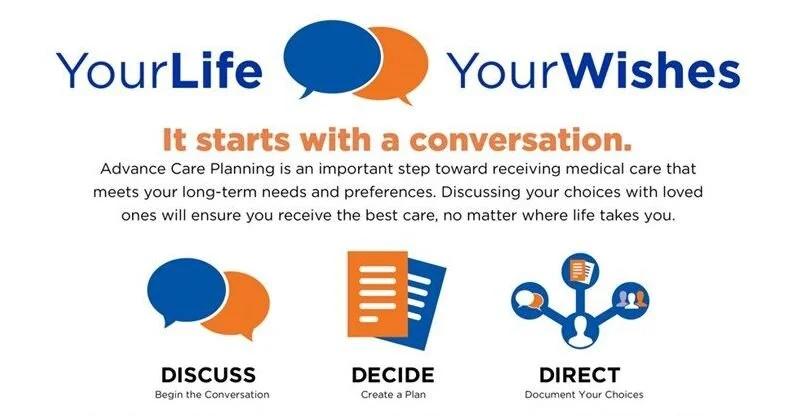
A new year brings new opportunity to get to some of those "to-do's" we may have put on the back burner. Take advantage of this slower time of year to focus on Advanced Care Planning. 

The webinar series has been designed to help you understand Advance Care Planning and what forms (advance directives) are available, how to complete the forms and best practices to follow when completing the forms.

Below is a list of the webinars, to register click on the link below. There is no limit to how many you can register for and they are all FREE!


Complete Your Medical Power of Attorney
January 22, 2021 at noon
February 10, 2021 at 10:00 am

Complete Your Living Will
February 17, 2021 at 10:00 am

Advance Directives or Doctor's Orders
February 24, 2021 at 10:00 am

Financial Advance Directives
March 8, 2021 at noon

Complete Your Financial Power of Attorney
March 15, 2021 at 1:00 pm

Legal Guardianship and Conservator
March 22, 2021 at 1:00 pm

Last Will and Testament
March 29, 2021 at 1:00 pm

* There will be one webinar provided in Spanish

Complete Su Carta Poder Médica: Tutorial Paso-a-Paso
February 18, 2021 at noon


CLICK THE LINK BELOW TO REGISTER
https://www.senioranswers.org/advance-care-planning-webinars/

What Every Retirement Saver Needs to Know About 2021

960x0.jpg

New rules for savers, beneficiaries and taxpayers 

Most people will miss 2020 about as much as they miss mosquito season. For many retirees and retirement savers, the year had a few benefits, such as some COVID-19 relief measures. Even without those, however, most of the retirement changes in 2021 are for the better. Here's a look at some of the most important you need to know.

Retirement savings plans

The Coronavirus Aid, Relief, and Economic Security Act, better known as the CARES Act, gave some big breaks to retirement savers. They are deader than Marley's ghost in 2021.

  • Required minimum distributions (RMDs). The CARES Act gave savers the ability to skip RMDs in 2020. An 80-year-old man who had $50,000 in his individual retirement account (IRA) at the end of 2019, for example, would have normally been required to withdraw $2,673.80 in 2020 and pay income tax on that withdrawal. He didn't have to do that in 2020, but he will have to restart taking RMDs in 2021.

  • Retirement plan withdrawals. The CARES Act also allowed people younger than 59 1/2 to take up to $100,000 from their retirement accounts in 2020 without the usual 10 percent penalty. Furthermore, it allowed people to spread out the tax on their retirement plan withdrawal over three years — and to replace that money in their accounts if they wanted to. (The withdrawals had to be COVID-related.) The early withdrawal penalty is back in 2021, and income on withdrawals will count as income for the 2021 tax year. However, the COVID-Related Tax Relief Act of 2020 (COVIDTRA) allows for the same treatment of retirement plan withdrawals made because of qualified disasters. To qualify, taxpayers must have lived in a qualified disaster area and suffered financial loss because of that disaster.

  • Retirement plan loans. The CARES Act allowed savers in 401(k) plans to borrow as much as $100,000 from their accounts, up from $50,000 in 2019, and to defer payments on those loans for a year. That change has been expanded into 2021, but you must meet the qualified disaster requirements listed above.

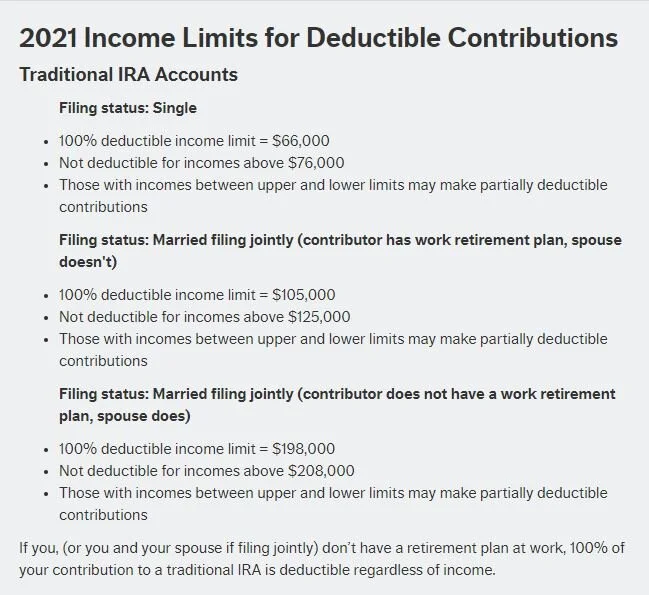
The amount you can contribute to retirement plans won't change in 2021. IRA investors can sock away $6,000 a year in 2021, and those 50 or older can add another $1,000, for a total annual contribution of $7,000. Investors in 401(k) plans and other similar workplace retirement plans, such as 403(b) plans, can invest $19,500 in 2021, also the same as 2020, with an additional $6,500 for those 50 and older. Is there any good news for savers in 2021? A bit. Although the amount you can contribute to an IRA is unchanged, the income limits on deducting a traditional IRA or contributing to a Roth IRA have risen modestly.

AARP Savers 1.JPG
AARP Savers 2.JPG

Social Security

Most Social Security beneficiaries will get a modest cost-of-living adjustment (COLA) in 2021.

In October, the Social Security Administration (SSA) announced a 1.3 percent COLA for Social Security and Supplementary Security Income (SSI) beneficiaries starting in January 2021. The average monthly Social Security retirement payment is up $20 to $1,543 from $1,523 in 2020. The maximum monthly Social Security benefit for a worker at full retirement age has risen $137 to $3,148 from $3,011 in 2020. Full retirement age is 66 years and 2 months for people born in 1955, and gradually rises to 67 for those born in 1960 or later.

The COLA affects other parts of Social Security as well. If you are receiving benefits before full retirement age and you work, you'll have $1 withheld from your benefits for every $2 you earn above $18,960 a year in 2021, up from $18,240 a year in 2020. Beginning at full retirement age, your benefits won't be reduced, no matter how much you earn, and your monthly check will be adjusted to compensate for any benefits withheld previously.

Even with the COLA, however, some see slightly lower increases in their monthly checks, because Medicare premiums are usually deducted from Social Security checks. Standard monthly premiums for Part B costs $3.90 more, rising to $148.50 in 2021, up from $144.60 in 2020.


Taxes

Taxes, too, will be different in 2021. Unfortunately, “different” doesn't mean “lower."

  • Social Security payroll taxes. Start with the taxes for Social Security's Old-Age, Survivors, and Disability Insurance (OASDI). The payroll tax to fund the program is set at 6.2 percent for employers and 6.2 percent for employees. The self-employed pay the whole freight: 12.4 percent. The rate won't change in 2021. What will change, however, is the maximum amount of income to which that tax applies. In 2021, you pay OASDI tax on income up to $142,800, up from $137,700 in 2020. The rate for Medicare's Hospital Insurance (HI) program remains at 1.45 percent for employees and 1.45 percent for employers (2.9 percent for the self-employed). It applies to all income.

  • Standard deduction. The standard deduction for couples filing joint federal income taxes in 2021 will rise to $25,100, up $300 from the prior year. For single taxpayers and married individuals filing separately, the standard deduction rises to $12,550 for 2021, up $150, and for heads of households, the standard deduction will be $18,800 for tax year 2021, up $150. Are you at least 65 years old or blind? If so there's an additional standard deduction of $1,350 apiece for married couples, up $50 from 2020. It's $1,700 for filers who are single or heads of households. The amounts double if you are both 65 or older and blind.

  • Medical expense deduction. For those who have heavy medical expenses, there's good news: Congress made permanent a temporary reduction in the income floor for deducting medical expenses. In 2020 and following tax years, you'll need to have medical expenses of at least 7.5 percent of adjusted gross income (AGI) to claim the deduction (vs. 10 percent in the past). If your AGI is $50,000, for example, you'll be able to deduct the amount that's above $3,750 from your federal income taxes. (And that's only if your total deductions are higher than the standard deduction.)

  • Federal estate tax. The basic exclusion amount on the estates of people who die in 2021 is $11.7 million. That's up from $11.58 million for estates of people who died in 2020. It's double for couples. Keep in mind, however, that some states impose their own estate and inheritance taxes on top of the federal estate tax.


by John Waggoner, AARP, January 5, 2021
https://www.aarp.org/retirement/planning-for-retirement/info-2021/what-every-retirement-saver-needs-to-know.html?cmp=EMC-DSO-NLC-MONY-SAPLA--NMCTRL-011221-F2-5149645&ET_CID=5149645&ET_RID=21912772&encparam=I49LUhmm37sXpAH78ebVQGASa4DB0YhNpG4n7qHm6GU%3d

What you need to know about Long-term Care Insurance

What is it?
Who needs it?
How do you access it???

Long-term Care Insurance is extremely beneficial for older adults to have as their care needs increase later in life. 

We often find our clients do have some kind of Long-term Care Insurance but they don't fully understand how it works when they finally need to access it. We can help you help through this process with our Long-term Care Consulting Program.

Call us today!

(720) 629-3050

Find out who won our 2020 Review Drawing!

customer_reviews_icon1.png

Anyone who left us a review in 2020 was entered to win a $50 Gift Card of their choice.

And the winner is....

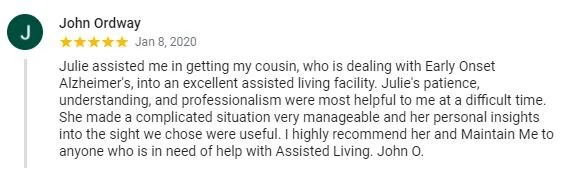
John Ordway

Congratulations and again Thank You for taking the time to leave us a review this year! Feedback of any kind is always welcome and invaluable in letting us know we are serving our clients and families to the best of our abilities. 

John Ordway 1.8.20.JPG

It's not too late! Leave us a review

its_not_too_late.jpg

DON'T WAIT!!!
You still have one day left to
leave us a review!

Anyone who has left MM a review in 2020 is automatically entered into our drawing for a chance to win a $50 Gift Card of their choice.

Have you worked with us as a client? In a provider setting?? A community??? We want to hear from any and ALL of you!

click here to write a review

What are your favorite holiday memories or traditions???

We had help from some of our amazing community partners to put together some residents favorite memories.

This has been a wild year but we wanted to finish it out by tapping into some local residents memories of wonderful years past.

No doubt everyone is looking forward to a NEW year but there is also so much joy that can be found in focusing on the beautiful memories we already have!

Wishing you Happy Holidays, Merry Christmas and a Happy New Year!

The Maintain Me Team


Special Thanks to:

Sean Turkington
Director of Community Relations
MorningStar of Wheat Ridge
MorningStarSeniorLiving.com

Diana Morefield
Director, Marketing and Admissions
Crossroads Senior Living
Crossroadsacl.org

MorningStar_Logo_410_293_s_c1_c_c.png
logo.jpg

Our Team put together a list of our favorite Christmas movies!!!

Christmas-Featured-image.jpg

The holiday season is in full swing and what better way to get a little R&R than to snuggle up and binge watch some feel good flicks!

Julie's Picks:
It's a Wonderful Life
The Holiday
Love Actually
Elf

Chelsea's Picks:
Saving Santa (2013) our tradition to watch on Christmas Eve!!!!
The Santa Claus (1994)
How the Grinch stole Christmas (2000)
A Christmas story (1983)
Love actually (adult 2003)
Home alone (1990)
The Christmas chronicles (2018)
The holiday (2006)

Morgan's Pick's:
* in no particular order, some kid friendly some not*
Family Stone
Elf
Klaus
Four Christmases
Just Friends
Home Alone

Jessie's Pick's:
National Lampoon's Christmas Vacation- The BEST!!!
Elf
How the Grinch Stole Christmas (the Jim Carrey one)
Home Alone
Christmas Chronicle's 2 (my daughter's favorite this year)
Polar Express (My son's favorite. Train + Christmas = No brainer)